
Organization – Transformation – Society (M.A.)
Today, more than ever, organizations bear social responsibility. As human-made entities, they reflect social conditions and, in principle, can be transformed through human action. In processes of social transformation, organizations exert a significant influence on issues of justice, inclusion, and diversity, thereby shaping the realities of people’s lives. Accordingly, organizations of all kinds recognize that, in addition to expertise, self-reflection and a critical approach to shaping spaces for change are necessary to support organizational change.
Through the part-time continuing education program „Organization – Transformation – Society,“ you will spend four semesters developing expertise in organizational pedagogy to study and advise organizations undergoing transformation. This program is designed for anyone who wishes to support organizations and their stakeholders in learning and development processes.
Fact Sheet
- Degree
- Master of Arts (M.A.)
- Admission
- Qualification assessment
- Duration of studies
- 4 semesters
- Teaching language
- completely in German
- Faculty
- Faculty of Humanities, Social Sciences, and Theology
- Start of degree program
- Winter semester
- Number of students
- <25
- Special ways to study
- Professional development program
What is the degree program about?
The part-time master’s program in Organization – Transformation – Society at FAU Erlangen-Nürnberg offers you the opportunity to develop and strengthen your expertise in educational organizational development, enabling you to address the societal challenges of our time.
In a diverse and, by design, inclusive society—one threatened by autocracy and the erosion of democracy, by wars and planetary crises—organizations play a central role: They not only respond to and adapt to societal changes, but they also shape society. In short: Organizations are responsible for societal transformation. The question of a just, inclusive, and diverse society is therefore always also a question of the possibility of a just, inclusive, and diverse organization.
From an organizational pedagogy perspective, the program addresses organizational development as intrinsically linked to societal transformation. Building on a foundation in the social sciences, the program offers a reflective professionalization in the field of organizational development that aims to foster a professional attitude and a critical awareness of problems. Both form the basis for an organizational pedagogical analysis and the design of organizational learning and transformation processes.
The guiding question “What the hell is going on?” and the reflective stance of “staying with the problem” are the fundamental pillars of professional development in the social sciences. They both encourage and challenge us to be curious, to allow ourselves to be unsettled and surprised, and to persevere with problems. They form the framework for an organizational-pedagogical way of seeing, thinking, and acting that addresses the following questions: What are the problems that are being addressed, discussed, or suppressed within and through organizations? How can spaces for dialogue and criticism emerge or be established within organizations? How can organizations be developed pedagogically?
- The program is divided into 12 modules. Core theoretical modules are closely integrated with units in organizational pedagogy. In the modules on reflective professionalization, students apply and reflect on what they have learned, thereby transforming methodological knowledge into practical expertise.
- You will find a detailed description of all modules in the module handbook. The program is governed by the academic regulations and examination guidelines.
- For detailed information on your study plan and schedule (course schedule), please contact jenny.kipper@fau.de.
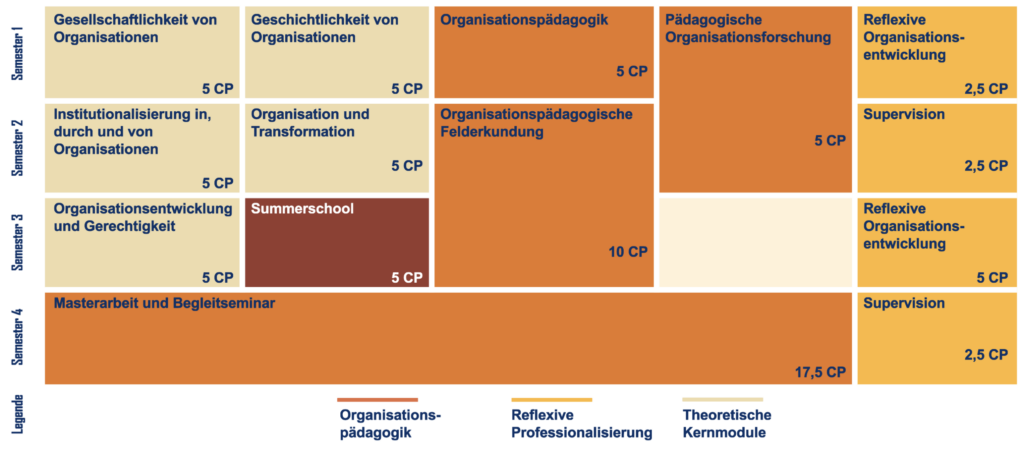
The program is pedagogically grounded in modern learning theories. The diversity of courses and instructors allows for a variety of theories and methods. The program thrives on small cohort sizes (max. 20 students), who spend the four semesters as a cohesive small group, ensuring that a consistently familiar working atmosphere facilitates continuous learning. The instructors are all experts in creating constructive learning environments. Core theoretical modules are closely integrated with reflective courses throughout the program. The organizational pedagogy courses provide the framework for both. Continuous evaluation and a closely knit, familiar team of instructors ensure the transfer of knowledge and quality throughout all semesters and create spaces where negotiations, dialogues, and (self-)reflective processes can take place based on social science theory and organizational development methods.
Admission Requirements and Application
The following information is intended for German applicants as well as domestic applicants with foreign educational qualifications. Different regulations and deadlines may apply to international prospective students.
Admission
- Master: Qualification assessment
Application deadline
- Winter semester: 27.09.
- Summer semester: not possible
Content related master requirements
Formal admission requirements include a successfully completed degree from a university or university of applied sciences, as well as at least one year of professional experience after graduation.
If the formal admission requirements are met, admission to the program is determined through a selection interview.